- At the heart of Kolkata,
lies the majestic Royal Calcutta Turf Club, known for the aura surrounding
horse racing.
- The Calcutta Turf Club was founded on 20th February 1847
in Calcutta with 5 members. Horse events and sports were initially held for the British
cavalry at Akra before they were moved to the Maidan.
- The first race was held
in India on 16th January 1769 at Akra where they continued for the
next 40 years. Races were also held at Garden Reach and Barasat. At Barasat the racing ground was near the residency of Warren Hastings.
- Governor Lord
Wellesley disapproved and banned horse racing in 1798; but five years later, the
Bengal Jockey Club was formed to resume racing at Akra. The races moved to the
Calcutta Maidan in 1809, where they have remained. The club laid out a new
course in the southwest part of the Maidan in 1812, at approximately present
racecourse location.
- After the closure of the Tollygunge racecourse, a new
racecourse was opened by the club in Barrackpore during the 1920s; it was
unsuccessful due to poor attendance.
- The main objective of the Calcutta Turf
Club was to regulate all aspects of horse racing in the city. The club came to
have the same authority as the Jockey Club in England.
- RCTC became the foremost
horse-racing organization in India and was the governing body for nearly all
racing events in the subcontinent. The races were inaugurated by the Viceroy of
India and attended by social stalwarts. The Royal visit of King George V and
Queen Mary to Calcutta in 1912 marked a prominent event in the history of the
club. Lord Hardinge and Lady Hardinge welcomed them. The winning horse among the 18 contesting ones received the King's trophy. The name 'Royal' was added to the Turf Club after this event.
- Previously, Prince of Wales, the future King George V, attended the races in
1905. The Maharaja of Burdwan, Bijay Chand Mahtab, was the first Indian to be
elected a full member of the club in 1908.
- Besides racing, the club also held polo matches
during the late 19th century. It hosted English-style gambling; the
Calcutta Derby Sweeps, which was the world's largest sweepstake in the 1930s.
- Maharaja Sawai Mansingh of Jaipur met his future wife Princess Gayatri Devi at this very ground.
- In 1961 Queen Elizabeth II visited the racing grounds with Prince Phillip, the Duke of Edinburg. The Queen's cup was initiated in her honor. As per records, out of 20 competing horses, horse number 9, Swinburne emerged as the winner and the recipient of cash prize.
- The rules of racing were largely laid by Lord Wolrick Brown and then by Sir William McFarson.
- A
grandstand was built in 1820, which was later extensively modified. Today it is
a private club at 11, Russel street and operates at Course in the Maidan. The
club was housed in the former home of the Apcar family: a two-story, Palladian
building dating to the early 19th century.
- The new grandstand, built
between 1905 and 1907, was open to the public along with stand membership.
First timing device was also introduced in 1907. Today, Kolkata Race Course has
three stands since 2020, including a three-tier main grandstand. The other types of galleries include reserve stand, member's stand, monsoon stand etc. The tracks for monsoon derby are laid differently from winter derby.
- Races are
primarily held on Saturdays, and sometimes on weekdays. The Monsoon Meet (from
July to October) is followed by the Cold Weather Meet, from November to April.
The club continues to hold polo matches on the infield of the racecourse as
well as training sessions for riders.
- The horses come out of the stable into the saddling paddock where they are dressed for the races. Then they come to face the stewards, jockey and betters before starting the actual race.
- Currently there are 500 to 600 horses which run at the Kolkata Maidan. Previously, horses were imported from Portugal and Argentina.
- Jockey is mostly a male dominated profession. While no women jockey is seen in Kolkata, India has a few of them, Rupa Singh being a famous one. In 1978 Silva Storey, a women jockey of international repute visited Kolkata. Famous bengali jockeys include Ajoy Ray, Pintu Das.
- Armenian industrialist J. C. Gaulstaun built an enormous fortune at the grounds of Kolkata Race Course. Horse racing has been a sports associated with extremes in making and breaking of fortune of the betters involved.
- Sartorial and culinary elegance are characteristics of the racing days.
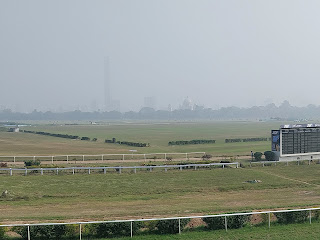 |
| The race course |
 |
| The iconic elevator |
 |
| The grandstand |
 |
| The entrance |
 |
| Viceroy Cup Day, 1910 |
 |
| The Logo at its inception |
 |
| The grandstand before 1905 |
 |
| The club house in 2015 |
 |
| Ticket dating back to 1934 |
References:



Comments
Post a Comment